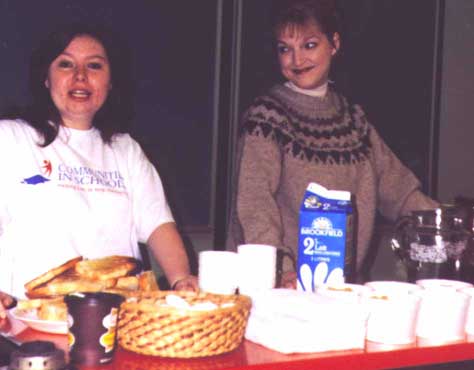
CIS Coordinators, Florence Courtney and Denise Osmond get
ready to serve up some breakfast for Stephenville Integrated High School
students at this years Breakfast Club Program.
These are some of the programs implemented by CIS Newfoundland and described here by the community co-ordinators themselves.
1. Fast Track to Entrepreneurship:
by Cheryl Hayden
Orientation workshop:
At the beginning of the Fast Track to Entrepreneurship Program, introducing both the program and its participants to the community at large is essential. The Orientation workshop is intended to provide program participants and organizers with an opportunity to build a supportive network of individuals who are willing and able to help with various components of the program.
The orientation workshop for this year was very successful. Approximately forty participants attended. Those present included, Fast Track participants, parents and advisors, representatives from the business community, service organizations, financial institutions representatives, community development officers, representatives from local colleges and members of the local press.
The orientation workshop gave participants an opportunity to network and to meet people from the community that they would not otherwise get a chance to meet. Participants left with the feeling that they had the support of the whole community behind them. We held the workshop on a Sunday afternoon, giving the young people who participated something worthwhile to occupy their time on an otherwise "boring" day.
Skill training workshops:
We have not only provided an introduction to the business community, but we have also given Fast Track participants a series of skill training workshops. The program provides skill training areas such as: Record Keeping, Estimating, Marketing and Promotion, Quality and Customer Service, and the Internet.
It has been part of my job as the Fast Track to Entrepreneurship Program Co-ordinator to mobilize our community and to get volunteers involved in the Fast Track training process. The response from the citizens of Stephenville has been very positive. Much like the Orientation workshop, the basic Skill Training workshops rely heavily on the participation of community volunteers. Volunteers are essential in ensuring the success of the training workshops. We ask volunteers to attend workshops to share their experience and expertise in business.
Fast Track skill training workshops give young people practical training that is very helpful to them when they move into the operational phase of their business venture. Micro business ownership is also an excellent way to develop problem solving skills and to foster self reliance. Beyond the development of business skills, skill training workshops give participants the opportunity to develop relationships with peers who have common interests, and to develop a rapport with local business professionals. Local professionals who volunteer also benefit, we have given them the opportunity to share ideas and to talk with teenagers, who they would not normally know or interact with.
Participation in programs such as Fast Track to Entrepreneurship and other programs that Communities In Schools Co-ordinator's have initiated, give young people opportunities to grow, learn and to connect with adults who care about them. We can compare children with flowers. They need sunshine in their lives, a secure place to grow, and someone to help foster their healthy development. If we can compare children to flowers, we can compare CIS Co-ordinator's to farmers, who ensure that they nurture the seeds planted, so that the seeds can blossom into beautiful flowers.
Mentorship program:
For centuries, people in all kinds of professions have learned their skills and trade by watching and working with more experienced people in the field of work they want to do. From an artist learning at the elbow of a great painter, to a salesperson learning by going on customer visits with a more experienced individual, nothing beats having an experienced person to learn from or to turn to for help.
We have paired all Fast Track participants with an adult from their community who acts as a mentor/advisor. It is the role of a Fast Track advisor to assist their protegee in the operation of their enterprise, for the purpose of helping to solve problems and situations by:
1. Being careful not to always provide the solutions, but rather to foster creative approaches which will necessitate the young entrepreneur's need to participate in and lead their own problem-solving process, thereby helping him/her to learn through experience as well as advice.
2. Referring him/her to individuals and/or resources that may increase their opportunity to find or develop such solutions to meet their needs.
Participants can choose their own advisor at the discretion of the program co-ordinator, or if they are unable to find a suitable advisor, the program co-ordinator can assist in making a suitable match.
At the beginning of the program we require advisors to sign an advisor commitment contract in which they agree to meet with their protegee at least once per month. It has been my experience this year that if the mentor/protegee relationship develops properly, meetings are much more frequent than once per month. Much like a friendship, the child and advisor will meet regularly and not limit themselves to meeting just once a month. I have also found that once they establish a relationship, the advisor begins to care about the general well-being of the child and help/guidance is not limited to business advice. This year, advisors have aided in the development of self-esteem, public speaking skills, research skills, and career exploration, just to name a few.
It is essential that young people have a positive influence in their lives, and someone who genuinely cares for them. One participant's mom noted that, "there are some things that he just doesn't want to talk to us about, his advisor is a responsible adult other than us that he can talk with - and I know he will always get good advice from his advisor."
Community service activity:
Included in the Sponsor/Participant agreement signed by all participants at the beginning of the project, is a stipulation that all participants must carry out at least one community service activity. The activity is likely to be an esteem booster and may even develop business or networking opportunities. More importantly, it is essential that young people who participate in the Fast Track to Entrepreneurship program recognize the importance of individual contributions to the well-being of their community. Exposing young people to the rewarding experience of volunteer work helps to increase the chances that they will participate in that type of activity again. As current and future business people, it is imperative they understand that if they plan to take from their community, they must also be willing to give back.
This year some Fast Track participants put together a bowling team for the annual "Big Brothers/ Big Sisters Bowl for Millions", a fantastic time was had by all those who participated. Other participants decided to do their community service work on an individual basis. One participant who is in the computer servicing and sales business did a computer badge with the local Girl Guides. A very innovative way to promote a business.
The Fast Track to Entrepreneurship community service component enables young people who participate with the opportunity to give back to their community and their peers. All participants who were involved this year reported feeling good about what they have done for their community, and best of all, they had fun doing it!
2. Peer Youth Tutoring: by Denise Osmond
Through Laubach Literacy of Canada, I am pleased to say that many students at the Stephenville Integrated High School have received extra help with their reading and writing skills, while increasing self-esteem, and even learning how to interact with their peers to become tutors themselves. The Peer Youth Tutoring program was brought to this school in January, 1998, through the training of Isabella Fry who trained twelve young people on how to become a peer youth tutor. These students received a certificate for their twelve hours of training, and all youth involved were very pleased with the training and the new skills that they had just learned.
Each of the students involved have been paired with peers who need extra help with not only their reading and writing, but also other subjects that they were having trouble with. I have seen many kids leave their peer tutor session feeling excited and energetic, ready to take on the next task with a new enthusiasm.
All of the students involved were faithful in showing up on time and ensuring that they didn't let their peer down. I believe teaching a young person the importance of time management is crucial to their successes in the future, and realizing that through this process they were, indeed, learning this skill as well, certainly adds to the thrill of watching them grow and learn as individuals.
3. Homework Haven: by Denise Osmond
Homework Haven at our school was held twice a week, Mondays and Wednesdays, from 3 - 5, and often during lunch hour, if the kids requested it. It was at this time that young people would work on their homework, study for tests, receive additional help, and, for some, just hang out and enjoy the peace and quiet. We provided an added incentive for the youth by providing after school snacks, which we received through in-kind donations from our gracious contributors.
Homework Haven did much more than provide a safe place for kids to learn and grow. Many kids learned the art of relationship building and became aware of the joy involved in sharing. Some kids blossomed from shy, reserved individuals, to becoming "part of the team". Watching these young people grow so much in such a little time, for me, was amazing. I learned a lot about teenagers, and recognized the need for making the connection between our youth who have to deal with tremendous adjustments throughout their young lives, along with the parents and other adults who feel intimidated in the high school atmosphere.
For several months, we had a volunteer parent who would come in and help with Homework Haven. I feel certain that this parent gave to many of these kids in ways that they will never forget. She was there to provide encouragement, a smile when needed, a gentle prod to the right direction when some of the kids would tend to stray. It is that encouragement that can make all the difference in a kids attitude toward the adults who may otherwise make him/her feel alienated in their society. I would like to thank Mrs. Connie Warren for her devotion to the kids who attended Homework Haven.
4. Breakfast Club: by Denise Osmond
Indeed, the most challenging project I ever worked with as CIS Co-ordinator, was the Breakfast Club Program.
The initial idea for the Breakfast Club came from speaking with the Breakfast Club Co-ordinator of many different schools in the Stephenville area, Ms. Theresa Hynes. Her enthusiasm for the program along with a heartfelt desire to help these kids growth through ensuring that they have even the opportunity to eat their breakfast within the school before they attended their classroom, helped me realize the importance of the program.
After many weeks of research, needs analysis, interviewing, etc., the Breakfast Club started to become a reality. After putting together a committee of caring adults who agreed to take on the responsibility of continuing with this effort in the new school year, our next task was to apply for funding.
The School Children's Food Foundation of Newfoundland and Labrador gave us $600 to start up the Breakfast Club, and promised to match funds up to $400 that we would receive through fund-raising efforts in our community. So far, we have received $500 from the Lion's Club and over $2000 through selling bars. We have also received a large supply of juices from Shopper's Drug Mart and a cart of juices each month from McDonald's until the end of this school year.
Our committee members have arranged a volunteer schedule for each morning, bringing parents and other volunteers into the school to help out with this wonderful cause. We are pleased to report an average of 25 students attending the breakfast club each morning since February 7, 1998.
The Breakfast Club not only allowed kids the opportunity to have the most essential meal of the day, at no cost to them, but it also brought the community together by identifying the needs of our youth and working together to ensure that those needs are met.
6. Teaching Assistants: by Denise Osmond
Because of a constantly changing world, teachers are being asked to be much
more than their job description implies. They are asked to be mentors,
guidance counsellors, parents, disciplinarians, and so much more.
The teacher/student ratio is increasing ever so quickly, and the
demands on both the teacher and the student is causing stress in
many different ways.
As CIS co-ordinator, I have found myself working closely with the
guidance counselor at the school, often doing little things that he
just doesn't have the time to do. However, later in the year, I
became involved with his career education class and helped him teach the "Choices" computer program that many students found to be a little tedious.
I also helped another teacher with her career education class by teaching her students interviewing skills, and helping them with their resume writing, cover letters, business letters, what to expect in the world of work, etc.
6. College Connections: by Denise Osmond
The College of the North Atlantic is probably one of the largest resources we have in the town of Stephenville. After working with CIS for a couple of months, I believed that there was not a strong enough connection between the college and the high school students. I found that many students were not aware of what was in their own backyard, and since I had gone to this college myself, and received so much from this school, I felt a desire to give back a portion of what I had received.
Through the college connections, meetings have been arranged and carried out where members of the community, school teachers, and instructors of the college were able to give their views on what they thought would most benefit the youth of the town, and how the college and high schools could become better connected. These meetings alone have opened doors for a brighter future for both high schools - through accessing the college for skill development and training, and for the college - through public awareness and increasing enrollment possibilities.
7. Special Projects: by Denise Osmond
The students at the College of the North Atlantic are often required to complete field training, where they are asked to go out into the community and work with different organizations, businesses, etc, in a field pertaining to their course of study, and receive some first hand experience in their chosen profession.
Realizing this, I took the opportunity to include these students at the Stephenville Integrated High School by inviting students from the Journalism Department and the Community Studies Department at the College of the North Atlantic to come to our school and help the students and teachers with different curriculum requirements and projects they were working on.
Several students from both departments became involved with our school. Three students from the Journalism Department were involved in producing a CIS documentary, presenting to the English department at the high school, and putting together an information package, including a video and easy to read instructions on how to edit and produce a documentary. Another student took over the CIS Youth News and learned how to interact with students who needed guidance in layout and design.
8. CIS Youth News: by Denise Osmond
The CIS Youth News is a newspaper that was put together to ensure that all kids involved at the Stephenville Integrated High School would be aware of all CIS events, school happenings, and any news stories within the school. There have been four CIS Youth News published, and at least twelve students have been involved in the writing, layout, and production of this newspaper. Students were taught how to edit, scan photo's, and all other duties of any normal production of a newspaper. It was exciting to watch the kids take over the newspaper as their own - taking responsibility for the production and distribution of a paper they had worked very hard at publishing. It was obvious that they were as proud of their paper as I was of them.
9. Career Fair: by Sherry-Lee Vallis
In early October, my CIS co-worker, Florence Courtney, and I began the preparations for a Career Fair in our schools. On November 24-26 universities and colleges from around the province attended and spoke to the students about courses available, opportunities, loan information, tuition fees, etc. Overall, impressions were very positive. Students felt they were very well-informed, and, for the most part, it meant they were closer to making a career choice. Students received valuable information about graduating requirements. This project allowed students to learn more about the world beyond high school. The more they know, the more prepared they will be to make the proper career choices. This was a program that can prepare them for the rest of their lives!
10. Buddy System: by Sherry-Lee Vallis
In early October, I designed a school-wide "Buddy System", where Junior High School students became responsible for primary/elementary students for a week at a time. They acted as mentors, friends, teachers, etc. The students were responsible for getting together with their buddy to show them a skill and to teach them how to read, play a game, to do a particular task, or just to talk. Our school recognizes how important mentoring really is and therefore incorporated the matching of Buddies into regular class time, as this is definitely a student mentoring program. It provided the kids with a one-on-one relationship with a peer who cared. This event took place for about a month; but this is certainly a program that should be incorporated all year long!
11. News telecast Team: by Sherry-Lee Vallis
Mr. Green, a high school teacher, and I established a News Telecast Team for our school. With assistance from the local Ramea Broadcasting Company, students of St. Boniface were taught how to use various video equipment, cameras, switchers, etc. Over 30 students have become involved with the news program. All of which were given a choice of what role they would like to fill - cameraperson, equipment operator, broadcaster, director, and so on. We have arranged the students in groups of six or seven who we take monthly to our local broadcast station to do a live broadcast. The students are responsible for writing and delivering news articles from the school and the community. This has provided the kids with a great opportunity to give back to their community and to express a talent that they have and can use in future endeavors. Students have received marketable skills such as producing news and using computers. Often the community is disconnected and misinformed about school happenings, this project has allowed residents the opportunity to see, first hand, exactly what happens at their school.
12. Speech Therapy: by Sherry-Lee Vallis
Although this is a School District #4 position, I am a local volunteer through CIS who has created a one-on-one relationship with a child that needs mentoring, care, and encouragement. Twice a week, "my" darling 'Guy' visits my office for instructional speech therapy based on the theme, "A Work Day". This therapy exposes him to a wide vocabulary pertaining to occupations, the tools they use and the duties performed. The relationship has taught me a lot about the importance of a child's need to develop speech in a safe place based in an atmosphere of trust and friendship. An opportunity worth taking!
13. Pre-School Early Start program: by Sherry-Lee Vallis
A program that enhances learning and allows pre-kindergarten students to visit the school on a regular basis and receive an early start in education with an adult who cares. Prior to last year our school had never offered a preschool program. With the efforts of the Community Literacy Worker, Mr. Lloyd Whiteborne, our school, for the first time in 1997, introduced the program with great success. Again this year I was able to organize a lesson plan which consisted of poems, stories, work and instructional activities, pre-kindergarten basics, etc. All of which are instrumental to a child's future. None of this would have been possible without the support of the volunteers who help out weekly with my lesson plan and teaching. Their support is tremendous. It is a really enjoyable program for everyone involved. The kids are the joy of my life! The little ones add an extra something to my day and at the same time get a great start on valuable life-long skills.
14. Tutors for Tuition: by Florence Courtney
Although the Tutors for Tuition Program is a Community Literacy Initiative established by School District #4, I had the pleasure of working with and becoming the co-ordinator for the four Level III students who were involved in this program. Because this program gives something back to the students by the way of an educational voucher they really take pride in their tutoring. Some of them have worked with special needs students, high risk students, and even just very shy and quiet kids who probably need the extra help but were afraid to ask for it. This program is a way for them to become aware of the help that is available and they see other people taking the extra help so they feel better about coming forward. The tutors take pride in their 'job' and quite often spend time preparing lessons and extra work for their learners. They realize that the improvements made by the learner in their school work, work ethics, homework and overall attitudes are a reflection of the tutors themselves. The tutors also attend Homework Haven and assist kids who want to take advantage of such programs. All in all everyone comes out with something positive.
15. Geography Tutoring: by Florence Courtney
Two students leave their regular classroom atmosphere and continue their lesson with me. They find that they get more work done, they can concentrate better, read aloud more which they find helps them out and they feel better about asking questions. Their grades are slowly improving but there is always room for more. The greatest improvement is their attitude toward school which will reflect on all of their courses. Again the positive attitude that develops is to me the most important of your role as a CIS co-ordinator.
16. Black and white photo: by Florence Courtney
Another project taken on by CIS was the Black and White Photography and it was a project that was slow getting off the ground. Again this type of involvement with the kids lets them learn a new skill, some may even take a greater interest and continue to use that skill. They could do projects for other courses, put articles in the local paper, learn how to do brochures and flyers, advertise school events, and work on the yearbook. The possibilities become endless when you mix a fun project with a few interested kids.
17. Student Distance Education: by Florence Courtney
Because of the uniqueness and newness of the CIS program, everyone in the different schools were involved with different projects. I was asked to help along with Mrs. Wanda Skinner, to oversee the Distance Education Students. The distance education set-up is in the same room as the Adult Basic Education Center so it is very convenient for me to supervise the kids and also get some of my own work done at the same time. We make sure that "work samples" are passed out and all the dates that assignments are due are all recorded on the whiteboard for the kids. The kids also like the fact that there is someone to come to or at least a connection between their school and the Distance Education Teacher. Distance education is a new experience for St. John Central High and I have been very happy to be of any assistance to this new and wonderful endeavour.
18. Student Mentoring: by Florence Courtney
A proposal was developed to have a Student Mentoring Program put in place at St. John Central High. This proposal was called "Keeping Kids on the Right Track". This was developed to help kids become involved in safe projects and learn a new skill as well. Our focus was to help kids develop their musical skills, and already the positive aspects of this program are being seen. Many students participate in the school's talent shows and jam sessions and the feedback that we get from everyone is nothing but positive.
The students feel good about themselves and the rest of the student body, as well, the staff enjoy their talents and the entertainment they provide. Overall it is a very useful tool to be used in the school, because while they are in the school they are in a safe learning environment and we would like for all our kids to have that option.
19. Accelerated Reader: by Timothy Simms
Truly, reading is fundamental, and this is where Accelerated Reader comes in. Accelerated Reader is a program whereby students receive incentives for learning to read, and it has created much excitement among the kids. For one hour each morning, children from all age groups get a chance to show that they are interested in reading and are eager to learn. As I look at the kids, all ranging from grades one to six, sitting in front of their computers, eagerly anticipating the results of their commitment to reading, I can see the levels of development throughout. The grade one student, breaking up words and sounding them aloud with the aid of a caring adult, to the grade six student who can come in, sit down with their novel, do their test and leave knowing that they are prepared for the next level of learning. For me, just knowing that I contributed to this has given me a real feeling of accomplishment.
20. Assistant Coach: by Timothy Simms
For me, sports are more than a hobby. Sports are a way for me to relax after a long days work, a way to interact with my friends, a way to get some exercise, and a way to engage in some healthy competition. I requested an assistant coach position earlier in the school year and was told that there was no need for one, but just a couple of months later, I received a phone call asking me to take on the role of coach, I was very exited. So that following Monday, the senior boys of St. John Central High became my own little bunch of students, and we began to work on turning a mediocre team into a well-oiled machine. The fact that I was given the chance to prove myself as a coach was what thrilled me the most, that, along with a great group of guys to work with. I really enjoyed my time as a coach and would readily accept the responsibility again if I were to have the chance.
21. Displays: by Timothy Simms
In order for a child to learn effectively, the environment in which they learn must be healthy and happy. From my very first day at A.J. Matthews Elementary I have tried, at every opportunity, to increase school spirit and keep the morale of the kids at the highest possible level. In the beginning, the displays I created were at the request of the teachers and staff, but as the months passed, I found myself looking at an empty bulletin board and seeing a place where kids could display their greatest academic achievements amongst a spectrum of colors and inspirational phrases. Every day when I went into the school I'd take the time to look at the new work and certificates that had been placed on the walls for everyone to see. When a kid came to me and said, "Mr. Simms, did you see my one hundred percent?!?" I would say, "Yes, I did, way to go!!!"
22. Primary Free Play: by Timothy Simms
The free play classes were established to give the primary level students an opportunity to experiment with the various programs available to them. After classes have ended for the day, students have the option of coming to the computer room for an hour to browse the system and use the educational programs or finish any work they may have. These free play classes were an excellent opportunity for me to take the time and get to know the primary students as individuals and to let them know that I was available any time they wanted help with their homework or if they had something they wanted to talk about. I feel these classes did wonders for the relationship that gradually developed between the little kids and me.
23. Computer Room Super Gizmos and Gadgets: by Timothy Simms
Gizmo's and Gadgets is a computer program that teaches children basic scientific principles, and it is one that has achieved great popularity with the students of our school. After I became accustomed to the various programs available to the kids, I found this particular program to be the one most beneficial, but at the same time, one of the most complicated "games" to play. So, at my own leisure, I began to create a "How to Play" booklet that was simple for the kids to understand. I feel that this booklet will be of great use to the students and will stay in the school for years to come. By doing this, I feel that I have left my mark in the school and have taken one more step toward creating a sounder learning environment for the kids.
24. Student Classes: by Tanya King and Bernadette Osmond
The student class program was initiated for students who were not performing well in their classes and tended to be difficult to deal with in a regular classroom setting. The students were referred by teachers, administrators and parents to work with us on a one-on-one basis. The program started with eight students and throughout the course of the year the number has increased to eighteen. We provided a place for these students to learn and grow and we developed a relationship with them based on trust and friendship.
These students have been successful in bringing their marks up and increasing their self-confidence and self-esteem. They have also developed better study habits and organizational skills which are very valuable assets to their future.
25. Parent Resource Centre: by Tanya King and Bernadette Osmond
We also considered parents when we began developing programs. Parents need a place in the school and it is hard for them sometimes to feel like they belong. We developed a Parent Resource Center at the school where parents can go and access a multitude of resources.
26. Public Forum: by Tanya King and Bernadette Osmond
During the month of March, we organized a Public Forum on "Children and Youth" which we hosted on the 30th of the month. The main purpose for the forum was to share information and initiatives relating to, and supporting youth in our area. There are many resources available to students in our area. The unfortunate thing is that most students do not know how to access these resources. The need for a connection between our youth and the resources in our community, is very strong in our area, and we felt that the forum would help to unite both parties. Many organizations such as Human Resources Development Canada, Gateway Development Corporation, and members of the Southwestern Mountain Zone Board were invited to attend, as well as principals and guidance counsellors from local schools and also, our local MHA, Bill Ramsay. The Regional Integrated Services Management Team from Corner Brook attended to provide information concerning their new model to help unite kids and resources. As well, the three Youth Corps in the area, (Communities In Schools, Community Service Officers, and the Community Action Team along with Family Resource Centers) made a presentation pertaining to the success our programs have had in the Port aux Basques area. It gave everyone an opportunity o share their positive experiences with the community and it gave us the chance to use a lot of the skills we have learned within our program.
27. Extra-Help Math Class: by Tanya King and Bernadette Osmond
One of the elective programs at the school include an extra help math class. Along with a grade nine teacher, we provide students with extra work assignments to increase their mathematical skills. This elective takes place in a regular classroom setting and also provides one-on-one assistance.
28. Study Notes/ Recording Novels: by Tanya King and Bernadette Osmond
Kids at a junior high level sometimes find it difficult to keep their schoolwork organized. We follow the objectives of each course and prepare study guidelines for each. These guidelines enable students to better prepare for exams along with teaching them proper organizational skills. In addition, we recorded a novel on audio cassette. This provides students who experience difficulty in reading with a chance to better a very important life skill.
29. Supervising Exams: by Tanya King and Denise Osmond
One student at the school has an 'Attention Deficit Disorder', and is removed from the classroom to complete exams. That student is placed with us during that time to give them a chance to organize their thoughts and achieve a better mark than if they were in a classroom setting. The student is placed in a room by themselves and is allowed to talk about their approach to each answer. As well if that student feels overwhelmed with information, they are allowed to stop and reorganize their thoughts before continuing. We supervise the students and sometimes encourage them to complete the exam. As well, we supervise those students who miss a regularly scheduled exam and have to complete it at a later date. This does not interrupt the class and allows the teacher to continue with his regular schedule.
30. Extra-Curricular Activities: by Tanya King and Denise Osmond
Throughout the course of the year we decided to get involved with extracurricular activities such as the drama club, singing group, and yearbook committee. We provided assistance to both the activity supervisors as well as the participants. We encouraged participants of the drama club and singing group to use their talent to their full potential. Those involved with the yearbook committee got to use their creativity along with organizational skills to create a Memory Book to share with their peers.
31. School Special Events: (fully described in Executive Brief: 1997-1998. See bibliography).
Battle of the Bands
Attendance Reward Day
Volunteering
Student of the Month
Spook Trail
Youth Conference
Literacy Tutoring
Western Regional Youth Parliament
Christmas Concert
Drug Awareness
Mentoring
School Spirit Week
Community Awareness
Recruiting Volunteers
Newspaper Articles
Community Television
32. Parents as Teaching Partners
33. Career Education Strategy