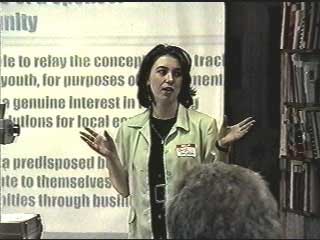
CIS Fast Track co-ordinator Cheryl Hayden enlisted the support of community resource people to provide the training in her 1997-98 program.
a) prepare ahead to ensure results
b) communicate with participants before the meeting to let them know the purpose and their role
c) involve participants and ensure that all opinions are heard
d) keep the discussion clearly focused on a results-oriented desired
outcome
e) provide direction to keep group members aware of their progress and the impact of their decisions
f) gain group members commitment to follow through on clearly defined action items
3. Conflict Resolution - Resolving Community Conflict
4. Expressing Yourself - Presenting Your Thoughts and Ideas
5. Electronic Labour Exchange
6. Building Better Career Futures
7. Program Development Training
2. Quantitative evaluation (Allison).
3. Qualitative evaluation.
4. Sharing Our Voices - Part One - User-Friendly Video. Refer to the video section of the guide.
5. Sharing Our Voices - Part Two - Telling Our Stories. On paper.
6. Divide group into teams of two. Different communities?
7. Task One - Interview and be interviewed. Answer the question by relating your personal experience. Use the video camera setup.
8. Task Two. On paper (half page to a full page) or on computer describe your experience. Answer the question.
9. Play back and discuss the tape.
10. How do we proceed with the process of working together to improve this program? Encourage everybody associated with the program - yourselves, the students, parents, school staff - to tell their stories, either answering questions on video or writing a memo.
2. Introduction to the Learning Guides.
3. CD-ROM demo.
4. Divide group into teams - Ramea/Burgeo; Stephenville/St. Georges, and Port au Port.
5. Describe community, school and coordinator assessments.
6. Work together at a table to discuss assessments; take notes and prepare a brief (half-page to a page report) description. People working together in a community can prepare one report; people working together in a school can prepare one report; each coordinator prepares a report. Either use the computer or write by hand.
7. Are there any categories missing? On-going discussion/keep it in mind.
8. Deliver reports to the group.
9. Any comments?
10. Next module focuses on raising community awareness about CIS - either through the mainstream media or creating your own. Think about ways to make it happen.
2. Accessing the mainstream media. Do's and don'ts.
3. Do-it-ourselves media.
4. Divide group into teams - Ramea/Burgeo; Stephenville/St. Georges, and Port au Port.
6. Work together at a table to discuss assessments; fill out assessments; take notes and prepare a brief (half-page to a page report) description. People working together in a community can prepare one report. Either use the computer or write by hand.
7. Are there any categories missing? On-going discussion/keep it in mind.
8. Deliver reports to the group.
9. Any comments?
10. Next module focuses on the participatory evaluation. Evaluation is a loaded term. But the purpose of the participatory evaluation is to improve the CIS process. We do this by thinking about the personal experience of everyone involved. Think about your experience in the youth corps.
by Allison Rice-Roberts
First Training Session
-Tracy Snow facilitated a Communities In Schools Orientation which involved a brief history about CIS, what CIS is, its philosophy, objectives and goals and what CIS means to the community.
-Communication / Listening Skills workshop facilitated by the project coordinator. This workshop looked at the communication process, for example, what is communication, the barriers of communication, using your behavior to influence communication the power of visual and verbal behavior and how to control it. Also, the workshop included a session on active listening (empathic listening) and the counselling process. The workshop ended with some role plays, practicing the active listening skills.
-Team Building and Group Communication, facilitated by the project coordinator. The team building workshop involved looking at what makes a team effective, the team atmosphere, characteristics of teams, individual and team commitment, team membership, identifying team roles, identifying and clarifying expectations. Also, the importance of group communication. This workshop included two activities; one about what does it feel like to be a valued team member and a team building creative brainstorming activity.
-Opportunities in the Labour Market
-Opportunities for Me
-Taking Charge