4. BACKGROUND AND OBJECTIVES
1. Overall goals of the organization:
The Community Education Network, Southwestern Newfoundland
The Community Education Network (the Network) is a not-for-profit community-based organization based in southwestern Newfoundland. It seeks to foster a community-wide interest in learning, and to provide both the means to learn and specific learning opportunities relevant to the area's social and economic challenges and aims to address them using a holistic approach - one that considers lifelong learning within a community context as a central part of the solution. To realize its aims in an era of reduced public funding, the Network facilitates partnerships between social service, educational and funding agencies; brokers programs and processes; and acts as an umbrella for learning projects and programs.
The Network builds on a decade of accomplishments attributed to the initiative and its partners, the shared values and goals of the partnership and its collaborative and joint planning efforts. Currently, the Network, identifies six components or strategic directions as priority areas:
€ Prevention and Early Intervention (a network of family resource centres, healthy baby clubs and pre-natal nutrition programs, empowering parenting programs, an infant care centre at our largest high school and action research related to understanding the early years)
Strategic alliances have been formed with groups and agencies throughout this region, as well as with those provincially and nationally. These alliances will continue to foster the creation of a more holistic vision of community, encourage more comprehensive responses to community needs, and integrate social and economic development at the community level.
2. Project fit within the goals of the organization:
The common ground between learning within a community education context and the methodology of participatory communications is respect for local knowledge and local ways of doing things. In both education and communications, learners and facilitators are peers in a long process of self- development and social awareness. The process mobilizes individuals to analyse and plan for their own future and the future of their communities.
We are all conditioned by our life-long experience as passive recipients of information from media and educational institutions. Therefore it requires a major effort to understand why it is futile to expect communication or education to effect a positive change unless the people themselves perceive the process as meeting community needs and being 'from here'.
There are no professionals in grassroots participatory communications; ordinary people plan the programming and operate the equipment. It is a common experience that when people take control of the technology that they grow in self-esteem and therefore are better able to discuss their situation and plan for the future. 'The community can and must take ownership over its own communication process'. (Fred Campbell, Ryakuga Grassroots Communication, Stephenville, Newfoundland)
The practice of respect for local ways of doing things - the common ground between community education and participatory communications technology - is essential for all educators and communicators who want to participate in development processes, which meet the needs of our rural communities.
As an expression of respect and a tangible step toward genuine development in our region, the Community Education Network has been involved will participatory communications strategies since 1993. This OLT funded project has provided the Community Education Network with the opportunity to support the Sharing Our Future Initiative (SOF) by:
€ providing administrative support where possible (i.e, take the lead in organizing meetings, teleconferences, etc),
3. Idea for the project
Since participatory communications is one of the six strategic directions of the Community Education Network and with the 30 year history of participatory communications in the province, the organization sees the project as furthering its mandate, but also playing a role in the ongoing evolution of community communications in the province.
In 1998, when the Office of Learning Technologies identified the development of Community Learning Networks (CLNs) in Canada as an important example of innovations emerging in response to the changing needs of the "new economy"..., the OLT showcased the Community Education Network among models of community learning networks in Canada (1998, Models of Community Learning Networks in Canada) and subsequently at the first Pan-Provincial CLN Conference in Ottawa in March1998. At that time, a video history of the evolution of community communications in NL was presented.
When we reviewed the proposal criteria for OLT Community learning Networks, it was obvious that our approach to grassroots participatory communications was a natural fit.
The design of Sharing Our Future project was informed by three initiatives in the region - Communiquer Pour Survivre/Communication for Survival (CFS), Communities in Schools (CIS) and the Long Range Regional Economic Development Board's (LRREDB) Talking About the Zone.
These initiatives gave us tools to utilize (such as the CIS participatory evaluation) but also practices from which we wished to diverge (such as hiring facilitators from outside the communities). They also provided us with many of our partners.
The major partners became the groups, which had shared in the earlier initiatives (CEN, LRREDB, CIS and Ryakuga). We used the OLT funded developmental stage to not only design the project but also approach community organizations, which might become local partners. Many of these had shared in the CFS initiative. In building our prospective steering committee, we also approached the College of the North Atlantic and Sir Wilfred Grenfell College (Memorial University). The Cormack Trail School Board, the Bay St. George South and Area Development Association and the Port au Port Economic Development Association also became major partners with in-kind contribution of office and meeting space.
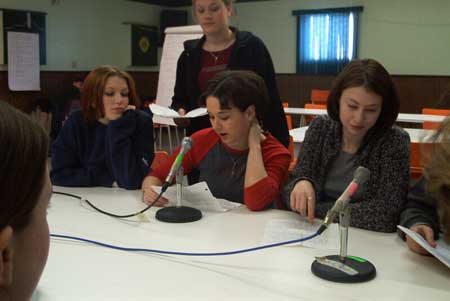
In Sharing Our Future, as another step in a 30 year evolution of participatory communications, all residents are targeted as learners. Specifically, the implementation of community communications aims to engage the population in discussion of local issues and to celebrate local culture. Youth media teams operate the technology after basic skills training. More than a 100 youth participated.
CIS field workers, who know local youth, became involved in the project partially because youth is the activating power of SOF (typically they operate the technology) but also because so many of the practices of SOF were informed by CIS. These practices range from the modus operandi of brokering the resources and skills of the community rather than trying to replace them, to training sessions for facilitators, to the importance of networking and local promotion. In total, about 20 community development professionals participated in the program.
A task for the SOF facilitators (16 in all) was to identify and approach community groups to be a bridge between them and the community at large. This focus probably struck full stride with the advent of special event community radiobroadcasts (15 community groups described their programs in the first event in November, 2001).
We have known for years that it is difficult to merely talk about the advantages of grassroots participatory community media. People have to experience it and SOF provided a first time experience for many people.
Our core group of partners who had the experience of CFS, CIS and Talking About the Zone, had already been exposed to the benefits of the process. However, our replication initiative introduced community media outside our traditional region. Roncalli High School has a renowned school based community media program but gained exposure to a community based process through the SOF experience. Lark Harbour, as a result of replication, got a community television outlet and a school based media program. Burnt Islands turned out to be an unexpected evolution beyond SOF with its unique community based media funded outside of SOF.
€ Youth Initiatives (a community youth network with alternative learning sites and transitional programs, Communities In Schools bringing together programs and community care in support of young people)
€ Community Literacy (inter-generational sharing and family literacy programs, as well as targeted literacy support)
€ Career Development & Enterprise (a career education strategy that incorporates community partnerships, broad career awareness, access to career information and early career planning initiatives)
€ Community Leadership (development of community leadership skills through workshops, roundtables and other formal and informal skills development opportunities)
€ Participatory Communications (the methodology of participatory communications is respect for local knowledge and local ways of doing things. Learners and facilitators are peers in a long process of self-development and social awareness. The process mobilizes individuals to analyse and plan for their own future and the future of their communities.)
All six components intersect, are mutually supportive and are linked together within a holistic model of community education where community education is defined as a process whereby learning is used for individual and community betterment. It is characterized by the involvement of people of all ages; the use of community learning, resources, and research to bring about community change; and the recognition that people can learn through, with, and for each other to create a better world.
Participatory Communications is one of six strategic directions, or priority areas, of the organization.
€ working with the SOF Steering Committee to secure administrative resources,
€ sponsoring the SOF webpage and listserv as needed and liaise with SOF partners to maintain the webpage / listserv,
€ working with/supporting the SOF Steering Committee to develop additional SOF projects through the Office of Learning Technologies and Industry Canada.
and by sponsoring an Annual Communications / Participation / Networking Training Event
€ implementing Zone related community television and/or radio programming in all communities with community television / radio at least twice per year,
€ assisting communities with community television / radio to develop programming by directing agencies interested in rural community issues to appropriate community television/radio groups,
€ assisting communities without community television / radio to establish the technology in their area by connecting them with existing groups,
€ assisting all groups / organizations concerned about communications / public participation with sharing of materials / resources and networking activities.
€ working with the School Board on the development / implementation of the Community
€ encouraging cultural exchanges at all public participation events / activities (i.e., musician exchange)
The zone board has been a major supporter of consultative community media since its provisional days. However, an unexpected development in our target group was the result of discussion at our first training/networking session. The relationship of community economic development and community communications became a major issue and, as a result, the theme of our second session. Subsequently, the zone board field workers attended all SOF events.
Expected outcomes of the project included the community-at-large learning more about grassroots participatory media and the place of Newfoundland and Labrador in the field; practitioners in community media would be able to assess the application of basic principles; practitioners in community media would learn new skills in internet technologies including software video conferencing and webcasting from rural communities; youth would learn practical community media application skills; people in rural communities would learn and develop strategies from a practical discussion of out migration, and expatriates would learn more about what is happening back home.