6. OUTCOMES
We expected the community-at-large would learn more about grassroots participatory media and the place of Newfoundland and Labrador in the field. This was accomplished not only by the media events themselves but also by promoting the project locally and writing a column in the community newspaper.
As practitioners in community media, we ourselves wanted to be able to assess the application of basic principles. For example, it is obvious from the SOF experience that youth volunteers are essential for community media but another question, such as insisting on facilitators coming from the local communities, may require more analysis.
We have been recognized internationally for our use of mixed media. So we saw this project as an opportunity to learn new skills in internet technologies including software video conferencing and webcasting from rural communities. We have surprised many professionals in what we have accomplished with low speed rural internet access.
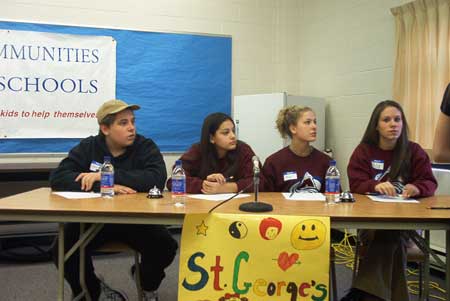
More than 100 youth have learned practical community media application skills. We delayed our final networking event to ensure that we would have youth participation in a conference that combined practical skills training with continuous television broadcasting and webcasting. We had expected youth to play a role but not as major a role as was evident in the final event.
We proposed webcasting for networking and so expatriates would learn more about what is happening back home. But it was probably the Email for Expatriates project, initiated by one of our facilitators, that made the most significant contact. As practitioners, we learned a lot about promoting webcasts. But it's a new technology and will need time to be accepted.
At the beginning of the project we had hoped that people in rural communities would learn and develop strategies from a practical discussion of out migration. But the topic was rarely discussed in the forums. A video we made on the topic (youth talking about leaving) turned out to be controversial and caused a negative reaction whenever it was shown. All in all, hard-hitting topics were often avoided in the SOF events. It's difficult to assess if it was a result of being on the pulse of the communities or hiring facilitators who were not community development professionals.
The Long Range Regional Economic Development Board was a major project partner. However, the project evaluation at our first training/networking session led to an unexpected discussion of the relationship between community economic development and community communications. This became a major issue and the theme of our second networking event. Also the community economic development field officers attended all SOF events.
In 2000, we were invited to present on our work at the first Global Community Networking Congress. Subsequently, we webcast plenaries of both the 2001 Buenos Aires congress and the 2002 event in Montreal. This unexpected development led to a partnership with the Victoria FreeNet and further experiments in software videoconferencing.